A Career Across Sectors: Building Communities Through Policy and Planning with Courtenay Mercer, AICP, PP, MCRP ’02,
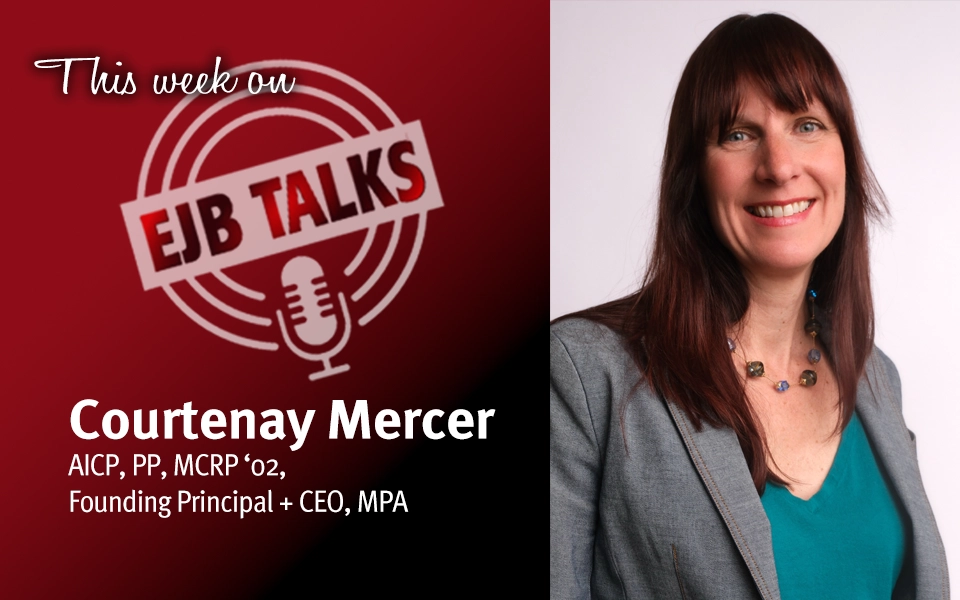
In our second episode of EJB Talks this season, Dean Stuart Shapiro speaks with alumna and Bloustein Advisory Board member Courtenay MercerAICP, PP, MCRP ’02 about her path from political science into urban planning, and her work across multiple professional environments including the New Jersey Department of Agriculture and the Regional Plan Association. Courtenay now runs her own consulting firm, focused largely on community engagement for transportation initiatives. These include Safe Streets for All plans and work with NJ Transit, as well as transit-oriented development and downtown economic development projects. Reflecting on her experiences in government, nonprofits, and consulting, she notes that politics shapes planning in every sector, though each role has taught her different perspectives and given her different tools to influence decisions. Her advice to aspiring planners is to gain experience even if a first job isn’t a perfect fit, do the work well, and build practical skills, especially proficiency in Excel.
Transcript
Stuart Shapiro
I’m Stuart Shapiro, the Dean of the Bloustein School, and the purpose of this podcast is to highlight the work my colleagues and our alumni in the fields of planning, policy, and health are doing to make the world a better place.
Welcome to episode 2 of our 15th season of the podcast. Our guest today is Bloustein alumni and member of the advisory board for the school, Courtenay Mercer. Welcome to the podcast, Courtenay.
Courtenay Mercer
Thank you for having me.
Stuart Shapiro
Absolutely. All right, we start with our origin question. You got your MCRP, your master’s in city and regional planning from us. What led you into planning?
Courtenay Mercer
Not engineering, which I know is a common answer. I’m not a failed engineering student. Instead, I was an undergrad at Rutgers, political science. I was going to go to law school and become a politician. That was the plan. But then I kind of realized I liked land use policy.
I had taken a geology class, natural resources and exploitation. That was really neat. And I minored in agricultural economics, which kind of has a land use bent to it. I knew nothing about planning, didn’t know it existed. And a little funnily, I ended up dating a landscape architecture major, and his roommate was a planning major at Cook back in the day. And I’m like, planning? That’s interesting. Tell me more. And that is the origin story.
Stuart Shapiro
I think that’s a first for our guests. I appreciate that. So after you were with us, you were in the government for a while. Tell us a little bit about that choice and also about what you took from that experience.
Courtenay Mercer
Sure. I think it happened, we were actually in a good economy for graduates then. And I had a friend who worked at Somerset County, who she was getting her master’s at night. And she said, hey, there’s a job, apply. And I did, and they love me, and I love them. And so, you know, I think your first job is just kind of luck and where you land. So that’s how I ended up being in government. And again, I think I did have that policy bent to me.
I’d say for the first 10 years of my career, eight years of my career, I didn’t actually do planning. I did policy. I was really more doing land use policy. I was reviewing regulations. I was writing regulations. I was reviewing other people’s work, but not actually doing any planning of my own. So, that’s so I think government was a logical, logical choice for me.
Stuart Shapiro
When you talk about regulations, you’re obviously near and dear to my heart, because that’s my area. Did a little bit of sort of your initial desire on politics feed into you, know, being where you were and enjoying where you were there?
Courtenay Mercer
Yeah, well, I think I actually didn’t last at Somerset County very long because I was doing land use review. But I was also doing a little economic development, working with that agriculture community. And again, it was a little more policy oriented and I really enjoyed that and did not enjoy land use review.
So I jumped over to the Department of Agriculture and was doing farmland preservation, which was, super fun. I got to go out on farms and, pet goats and all of that. But again, because of my policy bent, The Highlands Regional Master Plan legislation was being worked on at the time, and myself and another ag planner were both kind of policy wonks.
And the Secretary of Agriculture sent both of us 20 somethings to be his representative at these workshops to develop the Highlands Regional Master Plan legislation. So, I got my toes in there and then they also passed the state TDR act in 2004. And they’re like, and the Department of Agriculture has a role in that. And they’re like, who wants to do it? And I raised my hand and started working on it.
And that’s when the office of Smart Growth found me and poached me and said, you’re a policy, you’re not a farmland preservationist, you’re a policy person, come work for us. And so, you know, just progressive policy work around land use.
Stuart Shapiro
Yes, for so many of us, it’s path dependence, where we were and then, you know, it leads to where we go next. And every step is logical. On the way, even if the trajectory as a whole, you’re like, how did that happen? And so very much so. one of your next steps was the Regional Planning Association. Tell us what that is.
Courtenay Mercer
So it’s basically a nonprofit think tank. They generate research to inform land use policy development for the tri-state area being New York, New Jersey, Connecticut. It formed in the 20s. In recognizing that kind of what happens in New York City impacts New Jersey and Connecticut and vice versa. So at least first. long-range plan for the region in like 1929. There’s been three more since the last one in 2017.
Stuart Shapiro
Sorry, what was the year you said there?
Courtenay Mercer
29.
Stuart Shapiro
Okay.
Courtenay Mercer
Yes, 1929.
Stuart Shapiro
That’s quite the year for making plans.
Courtenay Mercer
It was. I’m not quite sure the timing of when it was done relative to other things that happened in 1929. But and they released the most recent one in 2017 and I actually got to work on that a bit while I was at RPA. They’ve influenced so many major policy and infrastructure initiatives in the region. And I was the New Jersey director, the main link between the org and New Jersey policy makers. At the time, the New Jersey director did a pretty balanced mix of project work and advocacy. So I got to work on some projects, like actually, ironically, the Highlands Regional Master Plan, the first review of the Highlands Regional Master Plan five years in.
I also got to do some TOD planning for the Dayton neighborhood in Newark, which is where they were going to extend the path to the air train. I wish they would still do the path, but at least they’re opening that station soon, so that’s pretty cool. For a policy, you know, we were just coming off Sandy, so obviously resiliency was big. And I was also there when then Governor Christie decimated COAH. and when he canceled the Gateway Tunnel. So that kept me busy. Yeah.
Stuart Shapiro
So what’s the relationship like between, I mean, we have all these stereotypes in our mind, of course, the relationship between, say, New York and New Jersey and Connecticut, but particularly for our interest, New Jersey. How do they interact, New York and New Jersey? Is there kind of a, we’re the big brother and we’re going to dictate terms here, or is it more of a partnership?
Courtenay Mercer
If you think about it like the Port Authority, the president, when the leader is always from New York, the second in charge is always New Jersey. It’s never vice versa. You know, I was actually just talking with somebody about this, though. Our two current governors, Hochul and Cheryl actually seem really interested in working together, and maybe this is a woman thing. They seem to be more collaborative and not like who has the bigger stick. So I do think we’re going to see some cool, interesting stuff.
We’ve also got like Mamdani coming over and working with the new Jersey City mayor and vice versa. I do think that everybody kind of finally gets it. And maybe it’s the housing crisis that’s driving that because New York can never develop all the housing it needs. And so we are the pressure valve, particularly Jersey City and Newark. But we’re the ones providing the housing for New York City’s workers. So yeah, I think there is finally recognition. Yeah.
Stuart Shapiro
I would imagine there’s also a little sense of being besieged by things like the gateway funding and things like that going on as well.
Courtenay Mercer
Yeah.
Stuart Shapiro
So I want to give you a chance to tout what you’re doing now. Talk a little bit about your firm and what you do there.
Courtenay Mercer
Sure. So I like to tell people this. I started my firm because I was at the office of Smart Growth and got pregnant and decided I don’t want to drive down to Trenton every day with a baby. So I started my own firm and it worked out nicely. I was in a place in my career because I had been the director of planning. I was the newly elected president of APA New Jersey. So people knew me. So I was able to kind of start my own firm. And now it’s kind of evolved a little bit.
I was doing a lot of transfer of development rights because I was the expert in development rights back then, but it’s kind of evolved into community engagement, which actually I did a talk of women Bloustein graduates and I’ve also done other talks with women. For whatever reason, women-owned businesses tend to end up doing community engagement. I don’t know why. But we do, and I enjoy it.
So we do it mostly for transportation initiatives at this point. So we’ve worked on a lot of the FHWAs, Safe Streets for All plans. We do a decent amount of work with New Jersey Transit, both on service initiatives and TOD. And then we also have kind of a side gig is downtown economic development. So for a while, I was the consulting executive director of downtown New Jersey while still running my firm. And I’ve done strategic plans for downtowns and economic development plans for a few downtowns in New Jersey. We enjoy that as well. That also lets me do some policy stuff. So yeah.
Stuart Shapiro
So you keep your hand in that. So one of the reasons I wanted to walk through it, all the various positions you’ve had, is because you’ve had this great trajectory of being in the public sector, the nonprofit sector, the private sector. What kind of similarities and differences have jumped out to you as you’ve progressed through these various worlds?
Courtenay Mercer
Politics. It influences planning no matter which end you’re coming from. Even as a private consultant, you’ve got to deal with politics. Best laid plans sometimes sit on a shelf because leadership changed, or personalities. Sometimes they don’t even get done because of politics. You’ve worked all that time and then they’re just like, yeah, we’re done. We don’t want to talk about this.
So that is definitely all three of them, but I think your influence over the politics is a little different. As A consultant, I really have no control, right? Like I just have to deal and it is what it is, except that I can choose clients. So if there is a client that I have either worked with or I know to be, particularly not friendly to whatever initiative we’re doing, then I just won’t work with them, right? I have that luxury. as a public sector employee, sometimes you’re making the policy, but you also can’t necessarily comment on policy. So, if when I was at the Office of Smart Growth, I could in a back way tell DEP that I didn’t like something they were doing like face to face. But if there was a regulation or if there was a law coming down, I couldn’t go to, you know, the state house and say, no, don’t do that. And this is why. So it was a little more backroom type of negotiating and conversations.
And then nonprofit, even though technically you’re not supposed to lobby, you could advocate and educate. So, you get to go to the legislature and testify. So you’re a little more, got a little more influence there. Which one do you have the most influence between being in government and being outside? Hard to say. But yeah, politics.
Stuart Shapiro
So you’ve managed to achieve your goal of a career that at least is politics adjacent throughout.
Courtenay Mercer
Yes.
Stuart Shapiro
That’s excellent. So what advice…you said you’ve spoken to our students, but let’s talk broadly here. What advice would you give to current and aspiring planning students? And I suspect the word politics is going to come up again, but whatever else you want to throw in there as well.
Courtenay Mercer
I think, one is, your first job does not dictate what you’re going to do. So particularly if it’s not a great economy, take that job, right? Take that job, learn. Yeah, get experience and then and do that job well, because if you’re a good worker, your former employer, even if you leave, will still be happy and supportive. I lasted nine months at Somerset County. They still love me. They still support me. But then you can move on to something, just get some experience. And I think this is the Gen X in me. Work hard. Like, I don’t know, I’m not a nine to five person. If something needs to get done, get it done. Because your boss will really appreciate that, you know, but we’re bad with the work life balance thing. So I don’t know, maybe they have it right. I’m not sure. But you know, you’re young. If you’re young and don’t have kids, work your butt off and get ahead. So that way when you have kids, you can kind of relax a little bit because you have moved ahead.
So yeah, that’s kind of some of the advice. I could give lots of advice. Take a class in how to use Excel. Everybody like every you have your stats class and you’re using SPSS and all those other things. I haven’t used them since grad school. You know what we use? Excel. Know Excel. Learn it. Love it. will be what you do use all the time as a planner.
Stuart Shapiro
Yeah, I was just demonstrating Excel for my students this morning, actually. Yeah, no, I totally agree. I particularly agree with the first job question. I often tell students, you’re still at the age and you have the luxury to make mistakes, right? And so yeah, whether it’s taking that first job and it’s not perfect or even making the wrong choice, you’re building your resume and you’ll have other chances to go out there and fix and find something that’s better for you.
Courtenay Mercer
Yeah.
Stuart Shapiro
Courtney, thank you so much for this conversation. It was really, really helpful. I love the sort of breadth of your career and I think that’s great for students to hear about as well. Thank you as well to Tamara Swedberg and Karyn Olsen who helped make this podcast run. And we’ll be back in another week or two with another episode with experts from Until then, stay safe.