Alumnus Helps Rethink Jersey City’s Public Spaces:
A Conversation with Barkha Patel MCRP ’15
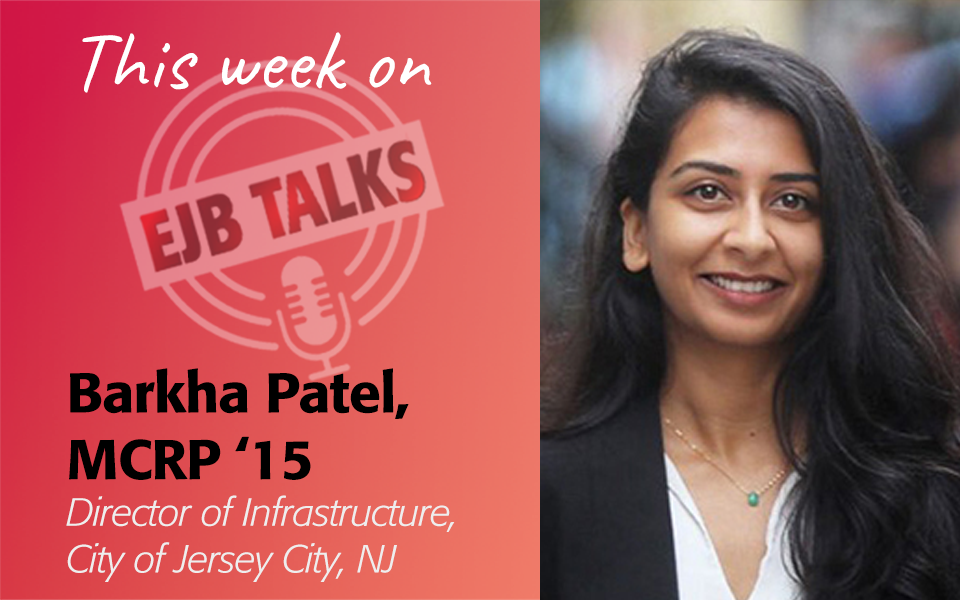
Dean Stuart Shapiro talks to alumnus Barkha Patel, MCRP ’15 this week on EJB Talks. Initially a sociology undergraduate at Rutgers, Barkha discusses how a chance visit by Dean Shapiro to one of her classes led her to urban planning, as she realized she could tackle social problems through the built environment. She explains how starting as a transportation planner, even though it wasn’t her focus at the Bloustein School, pushed her into tactical urbanism and set the stage for her current role. As Jersey City’s Director of Infrastructure, she leads a multidisciplinary team shaping everything from streets to parks to sustainability systems. She highlights Jersey City’s Vision Zero work, the effort to shift outdated traffic-safety mindsets, and her favorite project: transforming the historically significant but neglected Bergen Square area into a people-first plaza integrating mobility, culture, ecology, and design. She reflects on how the planning school fundamentals and communication skills she learned still form the basis for her work, and concludes with encouraging emerging planners to adopt an action-oriented mindset by becoming a person who figures things out and gets things done, even when they feel out of their depth.
Transcript
Stuart Shapiro
Welcome to EJB Talks. I’m Stuart Shapiro, the Dean of the Bloustein School. And the purpose of this podcast is to highlight the work my colleagues and our alumni in the fields of planning, policy, and health are doing to make the world a better place.
Today we are speaking with an alumni of our world-ranked urban planning program, Barkha Patel. Barkha is also the winner of our Young Alumni Award. And is the Director of Infrastructure for Jersey City. Welcome to the podcast, Barkha!
Barkha Patel
Thanks for having me!
Stuart Shapiro
So we’re going to start like we always do, with sort of talking about origins and such. Why urban planning?
Barkha Patel
Uh, well, it was because of you Stuart! ((laughing))
Stuart Shapiro
((laughing)) I was afraid you were going to say that.
Barkha Patel
((laughing)) Does everyone say that when they come on?
Stuart Shapiro
No, they don’t. But I’ve heard you tell this story before.
Barkha Patel
Um, no. But in all seriousness, I was a sociology student at Rutgers University. And I really, really loved that program. I loved being in classes talking about social problems. And you came to one of my classes and talked about the urban planning and policy program at Bloustein.
That was the first time that I heard someone talk about social problems and then addressing them through the built environment in a physical way. And that just had never clicked for me before. And it did when you spoke about it. And that was really what made me look into the program and apply and then go through planning school.
Stuart Shapiro
That’s great. I think clearly as people will see as we go through this podcast, this will go down as one of my better accomplishments.
Barkha Patel
((laughing))
Stuart Shapiro
My time at Bloustein was getting Barkha involved in urban planning.
Barkha Patel
((laughing))
Stuart Shapiro
Now you come here, you get your Master’s in City and Regional Planning. Tell us about the first job you had.
Barkha Patel
My first job was as a transportation planner for the City of Jersey City. So I still work for the city now. The first position was transportation planner, which was really focused on conducting planning studies, getting grants from the NJTPA primarily, which is the North Jersey Transportation Planning Authority. And then conducting citywide planning studies or specific planning studies. And primarily that was the job. Transportation was not my specialty while I was at Bloustein, I was on the urban design track. But I was just always enamored with Jersey City. Every project I did at Bloustein somehow revolved around Jersey City. So I just really liked the opportunity to work here, and that’s what brought me there. But yeah, it was kind of serendipitous the way happened.
Stuart Shapiro
So did you feel like you were prepared to do transportation stuff, even though that’s not what you studied?
Barkha Patel
((laughing)) No.
Stuart Shapiro
((laughing)) But somehow you survived.
Barkha Patel
Somehow, somehow I survived. I think, as you know—and I’m sure many people who listen to this know—it’s hard to avoid transportation when you’re at Bloustein.
Stuart Shapiro
Right.
Barkha Patel
There’s such a strong focus on it, and it’s really a specialty of the school. And there are so many experts. So, even though I was on the design track, it was hard not to be influenced by all of the professors who were teaching about transportation policy and best practices. So I had enough of a foundation where, you know, intentionally or unintentionally I felt like I knew the principles and could take that into a job.
But no, it was definitely not my specialty. And I really just wanted to work for Jersey City. It was really as simple as that for me. And interestingly, though, me starting with the city in transportation is what was the catalyst for all of our tactical urbanism work that we do now today at a citywide scale. That was where it started. So I’m very grateful that that was the opportunity that I had very early on.
Stuart Shapiro
Great. So let’s fast forward to the present. And now you are the Director of Infrastructure for your beloved Jersey City, there.
Barkha Patel
((laughing))
Stuart Shapiro
So what does that mean? What do you do as director of infrastructure? What does a day look like?
Barkha Patel
The Department of Infrastructure is something we formed a couple of years ago in 2022. So it’s not something that existed within city government prior. And as you know, because of the Faulkner Act, municipal governments are limited in terms of how many municipal departments that they can have. So in order for us to do this, we really had to restructure government in Jersey City to create an opening for a new department to be formed.
And I was then appointed as director of that department. And it takes every other agency in the city that has anything to do with the public realm, and combines it into one agency. So that’s the city’s engineering division, architecture, landscape architecture, traffic, transportation, sustainability. All of those are now under the Department of Infrastructure. And my job is to carry out the “big picture” vision of the city through each of those divisions.
And then. you know. day-to-day. to solve problems on the ground and make quick decisions in furtherance of that vision. And to make sure that we do it in a way that doesn’t deviate too far from, for example, us, you know, wanting to be a Vision Zero city. Us having certain climate action goals. Us wanting to have a certain amount of and type of public space available to our residents. Building buildings in a certain way. The city operating in a certain way.
So all of those things are involved. And the team that I manage includes like I mentioned, engineers, architects, landscape architects, transportation professionals, sustainability professionals. And my job is to lead that team of licensed professionals and make sure we’re all working in alignment to create these public spaces and streets and parks and buildings and everything. And then also to communicate and advocate for the things that are important to us to the many stakeholders, which is all of our elected officials, through Council meetings, all of our residents, through community engagement, external agencies. And really to carry out, you know, this “big picture” vision that we have for all public spaces in Jersey City.
Stuart Shapiro
That’s great. For our listeners that don’t know. Can you explain what Vision Zero is?
Barkha Patel
Yes, Vision Zero is the principle that started in Europe and has carried over into the rest of the world that the only acceptable number for the amount of people who die or get hurt on our streets should be zero. And that anything more than that is not acceptable for any of our towns, cities, communities. And Jersey City became the first city in the state of New Jersey to adopt a Vision Zero goal back in 2018.
And what that meant was, that we were going to reorient the nature of all of the work that we do for our transportation system to ensure that we are making them safe for the people who are the most vulnerable on our streets. We actually achieved that goal on city streets in the year 2022.
Stuart Shapiro
Mmm hmm.
Barkha Patel
So we had zero deaths on any city streets in 2022, though there were still fatalities on county and state roads that go through Jersey City in that year. And every year we are trying to build or rebuild infrastructure in the city so that we can make it as safe as possible for the people who are the most vulnerable.
Stuart Shapiro
That’s great. Well, that leads right into my next question, and maybe this project is your answer, but maybe you have a different one. Can you describe a particular project you’ve worked on and the challenges that you had to overcome that meant a lot to you?
Barkha Patel
Yeah, the Vision Zero program is definitely one of them. And the challenge there was that, we were sort of flying in the face of the way things have been done for decades and decades in relation to transportation planning and traffic safety. And trying to get the entire city on board with this very, very ambitious goal that no one thought, one was possible and some people didn’t think that it was worthwhile because the general thought process around injuries and fatalities on streets is, this is just a natural byproduct. This is just something that happens and there’s nothing we can do about it. So that was a really challenging one and remains so, as we see the ebb and flow of you know, a ton of support and investment into these projects and us seeing the results. And then once again in the city and at the state level and nationally, trends of really, really alarming statistics about, you know, the number of people who are losing their life on our streets. So that one remains a challenge.
Another one that I really go to often is this Plaza that we built on Bergen Square. Which is the oldest town square established in the 13 colonies of America.
Stuart Shapiro
Hmmm!
Barkha Patel
It happens to be in Jersey City. And it was once, you know, an amazing dynamic place. And over the years has been overtaken by asphalt parking lots, just a sea of pavement. And wouldn’t be recognized as a town square a couple of years ago if you went by it.
The reason I love that project is because it involved every single discipline within my department. So, it started as a thought exercise in trying to expand green space in Journal Square. Journal Square in Jersey City is a very, very rapidly developing and growing area. But it has very, very little green space, almost none. And there isn’t really a lot of city-owned land that we have to work with. So, we always try to carve out these little spaces from streets or from underutilized property that we do have control over. And the idea was always to take this square and revitalize it as a town square and to green it.
But what started as, you know, that problem that we were trying to solve turned into a lot of other problems that could also be solved by building out that Plaza. It included a separated and protected bike way, which is now the highest quality protected bikeway we have in our city. It runs through Journal Square. A ton of, you know, transit infrastructure. We folded in sustainability by introducing native plants and resiliency benefits into that Plaza. We brought in the history and culture of that being the oldest town square, but also the presence of the Lenni Lenape in that area. And brought in traditional artwork of the Lenape tribe into the Plaza itself and made it a permanent feature.
So yeah, and every step of the way we were challenged. Because all of those design decisions were things that people didn’t agree with. Something as simple as, you know, me not wanting to have any hostile architecture in terms of seating in that Plaza was challenged and we got a lot of pushback. And required us to fight every step of the way for those things. But it was really important for me to do that because—and one of the things I learned in a design studio at Bloustein was that—a marker of a of a successful public space is when you see the people before you see the space. And that is true of this Plaza today. No matter what time you go by, you just see it, you know, filled with people, and you hear the diversity of Jersey City on display when you pass by and you just hear a ton of different languages and lots of people. So to me, it was worth, you know, fighting each of those little battles and saying, there should not be dividers in the seating. And all of the seating should feel wide and expansive and comfortable and bringing in all those other disciplines, transportation sustainability, into a tiny little project is just very fulfilling for me.
Stuart Shapiro
That’s fantastic. It brings me to a question and you’ve alluded to it a little bit. What skills, from your degree, do you still use today and what do you wish you’d learned?
Barkha Patel
I use the design and transportation fundamentals that I learned in the courses every day. That’s what really helped form my basis of how I think about city building and what things we should be advancing and advocating for. Especially in a place that is so built out like Jersey City, where the work that we’re doing is really either retrofitting or adjusting as opposed to building, you know, from scratch.
Stuart Shapiro
Mmm hmm.
Barkha Patel
And graphical communications is something, I think, I use every single day. Communicating the idea to people who are not well versed with the language that we use, or the things that we talk about, and speaking about these things for the everyday person or for elected officials is so, so important to building consensus and getting everyone on the same page to do projects like this. That, you know, just 10 years ago, felt impossible to do in our city. And now people are saying we’re not building them fast enough. So that I think is really important.
I wish I had some basic skills like, knowing how to read a site plan, as soon as I got out of school and into my public sector job. But I really think those are the kinds of things that are best learned when you’re just thrown into a situation and you have to figure it out. I think there’s a lot to be said for that type of challenge. So yeah, but a lot of those fundamentals still, every day, come into play in my job.
Stuart Shapiro
Yeah, it’s hard because you only have two years.
Barkha Patel
Right.
Stuart Shapiro
And so, you have to decide what you’re going to pick up and what you can learn afterwards in that first job or second job after graduation. With that in mind, what advice would you give current planning students?
Barkha Patel
I don’t know that I have advice. I think they’re perfect and they’re doing everything great.
Stuart Shapiro
((laughing))
Barkha Patel
And they don’t need to change anything. ((laughing) I will say a mindset that helped me because I went into planning school, like I said, really not knowing exactly what it was.
Stuart Shapiro
Mmm hmm.
Barkha Patel
My only exposure to it again, was you talking about it in my one class. And I was sold. But I didn’t really have any practical background. I still didn’t really understand what the discipline was. And so I struggled a lot with feeling like I wasn’t as qualified as I would have liked to be in those years in grad school or in the early years when I actually started working in the field and in the public sector. And after many months of struggling with that early on in Jersey City, I think the mindset that really helped me was, just to try to become the person who got things done. Or the person who just learned how to get things done.
That is such a valuable trait and mindset for anyone to have in any field that they’re in. And it served me well because it made me have a bias towards action, instead of that, analysis paralysis, that happens a lot for us, because it tends to be a theoretical field until you’re actually practicing it. So that really helped me, you know, becoming the person who gets things done, becoming the person who makes my boss’s job easier. Those were just practical things, I think, that served me really well. And then once you become that person, years later, then the thing to learn is really owning the power of being the person who gets the things done. And then learning how to direct it in the right way. And being intentional about how you want to use that voice and that position that you have within any organization. So, I guess that’s more advice for people entering, you know, the workforce more so than planning students.
Stuart Shapiro
Well, they’ll be that. They will be entering the workforce.
Barkha Patel
Yeah, exactly. And I think in the middle of feeling really overwhelmed in this time right now where, I feel like a lot of the things that we talked about in planning are at the very forefront. More so now than I’ve seen ever before. Especially with housing. It is very easy to feel like you are just one person in this huge system and there’s nothing that you can do, especially if you don’t feel like you are the most qualified person for that job. I think we all suffer from that starting out. But having this mindset of just becoming the person who figures out how to get something done, and then does it, is something that can serve people well, I think, wherever they end up within the field.
Stuart Shapiro
That’s great advice and I think you’re 100% right on the action-oriented mindset. In fact, as you were talking, it almost sounded like you were describing how you become a Dean, as well as becoming a director of infrastructure at at Jersey City, Barkha, thank you so much for joining us today.
Barkha Patel
Thank you, Stuart.
Stuart Shapiro
A big thank you also to our producer Tamara Swedberg and to our marketing guru, Karyn Olsen. We will be back in a week or two with another episode from experts from the Bloustein School. Until then, stay safe.