Planning, Policy, Politics, and the Path to Office with Assemblywoman Katie Brennan
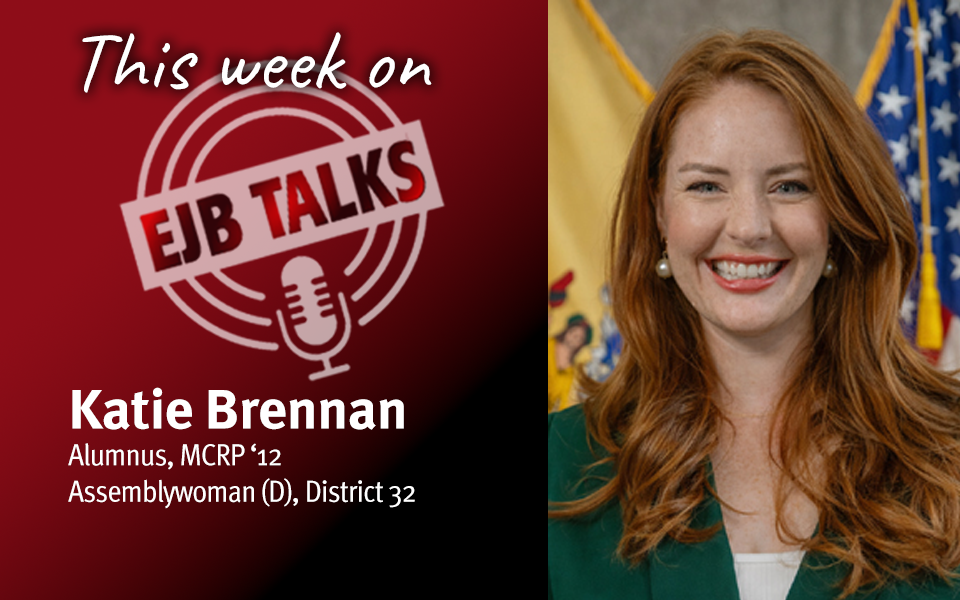
This week on EJB talks, Dean Stuart Shapiro talks to Bloustein alumnus Katie Brennan MCRP ’12, now an Assemblywoman in New Jersey’s 32nd District. Katie reflects on how her early exposure to housing instability, volunteer work, and her undergraduate policy studies shaped her belief that “everything is a housing issue.” She recounts her experiences in Cincinnati’s Over-the-Rhine neighborhood and her high school essay on housing instability, as well as her early positions in nonprofit roles and as chief of staff at the New Jersey Housing and Mortgage Finance Agency, as helping shaped her view on housing policy and its limits. Her decision to run for office was driven by a desire to help shape policy directly rather than just implement it. She also discusses the constant tension between good policy and political reality, emphasizing the importance of understanding politics and finance in policy and planning. Her advice to students is to learn how money and public finance work, show up to local meetings to get a sense as to what’s going on, and understand that planning, policy, and politics are inseparable if you want to create real change.
Transcript
Stuart Shapiro
Welcome to EJB Talks. I’m Stuart Shapiro, the dean of the Bloustein School, and the purpose of this podcast is to highlight the work my colleagues and our alumni in the fields of policy, planning and health are doing to make the world a better place.
Today, we are thrilled to have a recent winner of our Young Alumni Award and a recently elected member of the New Jersey State Assembly. Katie Brennan, welcome to the podcast, Katie,
Katie Brennan
Thanks, Stuart. I’m happy to be here!
Stuart Shapiro
So I know you’re an elected legislator, but we’re going to give you the same first question we give everybody, which is the origin story question. I’ve actually been made fun of asking this so often, recently. But I do think it, it helps our listeners. What got you into urban planning, which is what you got your degree with us in?
Katie Brennan
I like the origin story question! I when I was thinking about this, sometimes, when I answer this question quickly, I talk about a program that I did in undergrad. I was not somebody who knew what she was going to be when she grew up. You know, changed her major a million times. But I did a program called the Academic Service Learning semester.
And while most of those were abroad, Ghana, Nicaragua, India; I did one in Cincinnati, where my where my school was. And in retrospect, there are many aspects of the program that were problematic, but that said, you lived and worked in community, and all of my classes were about urban policy, basically. And that is where I learned the language.
And at the time, the neighborhood I was living in was really rough and I’ve never seen anywhere gentrify so quickly. It’s called Over the Rhine in Cincinnati. And that is where I learned the language of, okay, what is affordable housing? What is planning? And, even my first introduction to some of the more theory aspects of it.
But when I really think about it, about eight years ago, nine years ago, my folks were moving out of their suburban house and moving to downtown Baltimore. And my mom found my application for high school and where I had to write these essays. And I was talking about– and I had no recollection of this–I was talking about two things. One was a friend of mine, who at my, you know, suburban Catholic school, it stuck out because it wasn’t very typical. She had what I would now call probably some housing instability. And Gwen was living with family members and had this single mom. And when they were able to get their own place, how life changing it was.
The combination of that, and doing some volunteer hours at a women’s shelter, and talking about how so much of being able to leave a domestic violence situation is about housing stability, right? And access. So all that, when I look back at being 13 years old and writing this, to fast forward 10 years, plus later, when I was at… when I was at Bloustein. Now, what I say about how everything is a housing issue. It’s your access to transit and schools and a healthy environment and job opportunities, all of that. I kind of see the the build up over the course of my life.
Stuart Shapiro
That’s great. Well, it was not nearly as sophisticated, but I saw my elementary school yearbook recently, and everyone wanted to be a veterinarian, and I wanted to be a member of Congress. ((laughing))
Katie Brennan
I love that! There’s still time! When are you launching your campaign? ((laughing))
Stuart Shapiro
((laughing)) I think that ship has sailed.
Katie Brennan
No! ((laughing))
Stuart Shapiro
((laughing)) So you talk about housing, and you’ve held a number of housing positions before going into the Assembly.
Katie Brennan
Yes.
Stuart Shapiro
And I don’t want to pick one, I’ll let you pick one to talk about one that you’ve held and sort of what you got out of it.
Katie Brennan
Yeah, I have worked at every level of government. City, county, states, massive federal funds. I’ve been in nonprofits. I… and I think that that added a lot to my experience and understanding of the entire housing ecosystem. But one of my favorite jobs, even though it ended up being a personally difficult time for me, was as chief of staff at HMFA. I really loved that job. And when I went in to the state’s Housing Mortgage Finance Agency, as Chief of Staff, it was a big leap for me. And I’ll never forget what my boss said at the time. He was somebody who had been the Commissioner of the Department of Community Affairs. He had been through nine governors. He was in his 70s. I was 30. We had this, just, really beautiful relationship. Of, he had all this experience, and I was pushing him, and when he hired me, he told me, I want you to fight me and tell me no. Which I really respect. I want a thought partner, but you also got to keep the trains running. And I ultimately really loved that of, okay, how do I make this a better work environment and get marketing and HR and all of these components to be successful. But also got to do the really cool creative programs and pushing things forward.
But also being at a place like that state agency, you are touching, just, soup to nuts housing in New Jersey. Of, whether it’s subsidized housing, it’s vouchers, it’s home ownership opportunities, it’s small construction, it’s massive construction, it’s foreclosure and eviction prevention. It’s all of it. And that was really cool. And certainly was one step along the way that made me also appreciate the… my first government well… because, it wasn’t technically my first, but when I left a nonprofit to work for the county, I talked about how, you know, at the end of the day, you’re always subject to the programs and policies that are in place. And so, you might as well be making them. And kind of set me on my journey of working in a lot of government entities. But at HMFA, then you also see the limits of that. And what you might need the legislature or the governor to change.
Stuart Shapiro
So you’re segueing to my next question ((laughing)) and I love the sort of breadth of your experience. The nonprofit world, the state and local world. And we always tell students, there are many ways to make a difference, and all of those are legitimate. But one important way one can make a difference is by running for office, and that’s what you decided to do ((laughing)). And so, walk me through that decision.
Katie Brennan
Whew. So when I decided to stay in New Jersey after graduate school, I… if you had told me then that I would be in elected office, I wouldn’t have believed you. It was unlike, you in your high school yearbook, I was not…
Stuart Shapiro
Elementary school!
Katie Brennan
Elementary school!
Stuart Shapiro
((laughing))
Katie Brennan
I was certainly not thinking that that’s where I was gonna be. I didn’t even think I’d spend this much time in government, and really fell to love it. But, I did increasingly get politically involved. And had, through sort of the origin story of that, is actually some folks that I met at Bloustein in graduate school, people like Jorge Santos and others who are still around and in this world. And got me involved with, kind of, a progressive civic training organization. And through that, I grew my understanding of politics and government.
And over the years, people had said, oh, you should run. You should run. You should run! But if you go to summer of 2024. I absolutely did not think I was running for office. I was this close to taking a job in the federal administration at the CFPB. I thought, Oh, I’m going to be on the ground floor of the Harris Administration. It’s going to be awesome. And something kept nagging at me. And we also had these big mayoral races in Jersey City last year, and people were asking me to run for city council. And meanwhile, the line, as it were, which was Jersey’s only… ((laughing)) Only us in the nation, “gerrymandered ballot” that we had fell. It fell, and we had this brand new democracy, really, in New Jersey. And it just kept nagging at me, and I thought, you know what, I don’t want to run for city council. If I was going to be in an office, it would be state government.
And I decided to run. Turned down the federal job even before Harris lost. I would have been fired immediately. And it was crazy. It was a crazy choice because there was this kind of old school machine institution, and then there was whatever democracy is going to look like in New Jersey. And Rutgers and Bloustein and people like Julia Sasss Rubin played a big part in in that journey of getting this democracy in New Jersey. It was okay, you can wait till we figure ourselves out, or you can be a part of it. And I decided to be a part of it and run.
And I knew that I was not going to have the money or the institutional support or anything else like that. But that I had the community, and I often joked at the doors, and I still tell people, I know what this job is, and I’m trying to do it anyway, which probably makes me nuts. ((laughing)) But I won, and I’m here, and that has proven to be true. ((laughing))
Stuart Shapiro
Let me… I do a couple of callbacks to previous guests. Actually, you mentioned Julia Rubin. We do have an episode on her battle against the county line from a couple years ago. And you mentioned Jorge Santos. And I more, want to clarify that you’re not talking about the former congressman from New York, George Santos.
Katie Brennan
That’s right!
Stuart Shapiro
But Bloustein alumni and Economic Development Authority alumni, Jorge Santos, who also has been a guest.
Katie Brennan
Yeah, Jorge, with a J. Unfortunate name, I also know a Rudy Giuliani. ((laughing))
Stuart Shapiro
You do? That’s much rarer!
Katie Brennan
And they are related, though distantly, and…But he’s very different. He’s, you know, my age, worked in sustainability in New York City, and, but, yeah, its…
Stuart Shapiro
I can only imagine what his social media feeds ((laughing)) and mentions are like. ((laughing)) It must be awful.
Stuart Shapiro
So, you’ve been in office almost two months now. How’s it been?
Katie Brennan
A month and a half! You know, it’s been wild, but it’s great. New Jersey is… I can go down a whole rabbit hole about this….is not a full time legislature, although we absolutely should be. We don’t really go out of session. And what I mean by that is, in some states, it is very clear of, here’s when you’re voting, here’s when you have committee, and then you’re not. And you go back to whatever else your life is.
In New Jersey, they were voting until midnight the night before I was inaugurated. And you don’t really have a break. And you go down to Trenton multiple days a week or every other week, and… It has… so you’re trying to catch up with, all right, like what passed at the end of that lame duck session? What do we still need to do, particularly the high profile things, like, all of the immigration initiatives.
Stuart Shapiro
Right.
Katie Brennan
So catching up on that. Trying to introduce your own things. Making sure that you’re in the community and out there and serving people with… now that you actually have the tools for constituent services. And meanwhile, trying to make sure the printer turns on in your new office. And getting that set up. But it’s been, it’s been a lot of fun. And knowing, in my neck of the woods, the primary is the real fight. And while we had many elections, all the way until November of 2025. I’ve more or less known since last June that this was coming. And so I’ve been really, just kind of, chomping at the bit to get in there and get to work. And I’m enjoying it. And you also have your.. you know, this is not an executive position. You’re one of 80, you’re one of 120 with the Senate. You’ve got a lot of new colleagues to get to know, and that’s a challenge, but fun too.
Stuart Shapiro
So it’s early in your tenure to ask this question. But you have the campaign experience too. I’ve spent a lot of time, certainly in my research career, but also in other walks of life, thinking about the border between politics and policy.
Katie Brennan
Yeah.
Stuart Shapiro
And some people have this mindset that, you know, we need to do what’s best. We need to do what’s right. The analysis can tell us that. Other people are like, we need to do what’s popular. We need to do what can sell. You know, how has your experience on both sides of this divide affected your thinking about that?
Katie Brennan
I think about it a lot. And my, excuse me, my sort of, theory of change and how you effectuate things. Because I am a wonk. I am a nerd about this stuff. And I… you want to do what’s right and what’s effective. Words matter. There are lots of laws that are well intentioned and have disastrous consequences. There’s some things….there’s big, grand, sweeping programs you can do. There’s also little things around the edge of, okay, this this reg is not working for us, and this word has kind of hurt us in XYZ way that’s deeply unsexy. But also, probably easier to pass and get done. And it can help us with housing production or whatever it might be. But yeah, you have to bring people along.
And I’ve… having been kind of, harkening back to my previous experience of kind of having been on every side of this. And also been at the nonprofits and as an advocate. And how do you push from inside and outside and get things the attention they need to move forward. There’s so much to do, and everyone has their own priorities. The intersection of policy and politics, they’re, I know… I mean, thank goodness This hasn’t really happened yet, but, I know there’s going to be bills that are not great. And when do you really stick, you know, put your foot down and say, something like OPRA, the comptroller bill that, like this is actively bad. It’s actively bad. And I can’t, and I can’t vote for this. Versus something that maybe, is just kind of like milk toast, right? And… but it’s super popular, or there’s leadership that’s advancing it, or whatever it might be, and, and how do you pick your battles?
And is it every single one or… but also really knowing that, if you want any of your legislation to move, it has to get put up in committee. It has to be put up by the speaker. You’re going to have to have a matching bill in the Senate, and then the governor has to sign it. And, how you navigate that is, is really, is really tricky. And trying to find… I’m not someone who wants, kind of perfect to be the enemy of the good, but also has seen bad legislation and bad policy be ineffective at best and harmful at worst. So, certainly figuring it out on a case by case basis. But trying, trying to navigate that. And again, I think thinking about who can say what, and what are people’s roles as we, as we try and get stuff done.
Stuart Shapiro
Yeah, and you’ll have, you’ll have those bills that have things that you like in them and things that you don’t like in them. And you will be pilloried for the things you don’t like if you vote for them because of the things you like, there.
Katie Brennan
Yes.
Stuart Shapiro
And it’s a phenomenon everybody who served in a legislator…legislature has to navigate at some point.
Katie Brennan
Yeah.
Stuart Shapiro
Let’s conclude with advice for students. And sort of, both students that… or whichever you really think you want to speak to… students who are interested in careers in planning and policy, or even students who think one day they might run for office. What’s the advice to the, either the the 19 year old undergraduate out there, the 23,24 year old starting graduate school.
Katie Brennan
Two things. One, figure out…well, take, take a class about money, whether it’s housing finance or public finance or something like that. Nothing gets done without that. And trying to understand it on some level is deeply important. But also, and I think this gets overlooked sometimes You cannot exist in–certainly not in policy, but also in planning–without being involved in politics. Sometimes, now that I’m an elected office, people are like, oh man, you know that that meeting was brutal. Have you tried being a planner? Go to a planning board meeting. Go to a zoning meeting, whatever you have in your town. Go to a city council meeting. If you want, whether it’s you’re trying to fix NJ Transit or you want a bike lane on Franklin Avenue in Jersey City. You best go see what that is like in terms of, how you, how you get things done and effectuate change. Because the right thing to do, or it’s sensible, and even if it’s 100% paid for, you’re gonna… you might have a line out the door of neighbors that are yelling at you. And so, I don’t say that to scare anybody off, but…policy and planning and politics are really tangled together. And there’s no avoiding that. And so, I think learning how to navigate that and be effective. Go check it out for yourself.
Stuart Shapiro
That is…
Katie Brennan
And you might just get a be a masochist like me and get a bug for it.
Stuart Shapiro
Well, thank goodness we have masochists like you. ((laughing)) That is great advice. Assembly Woman Brennan, thank you so much for coming on the podcast.
Katie Brennan
Thank you for having me!
Stuart Shapiro
Also a big thank you to our producer, Tamara Swedberg and to Karyn Olsen, who make sure that this podcast happens. We’ll be back in another week or two with another episode with experts from the Bloustein School. Until then, stay safe.