
by Zoe Linder-Baptie MPP/MCRP ’18
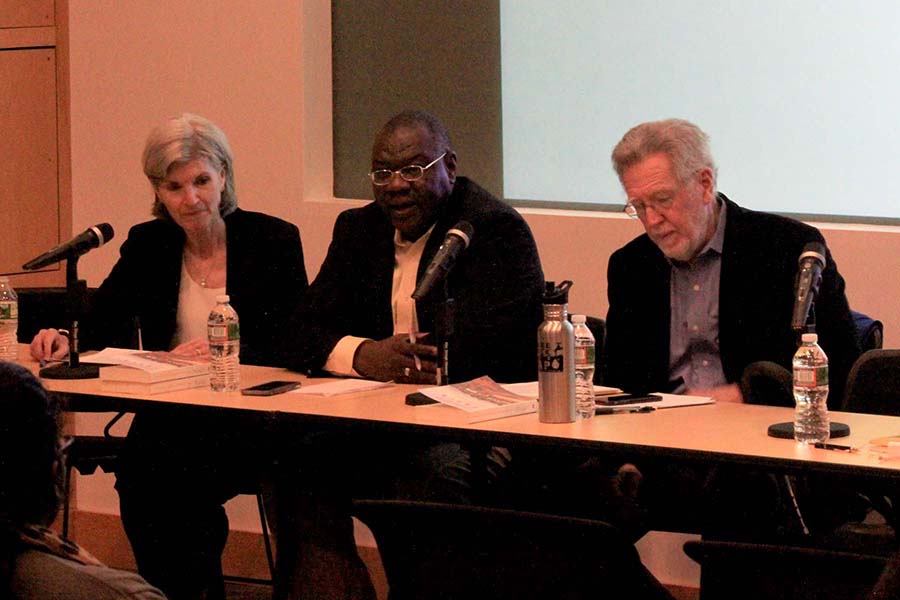
Francis Barchi, Professor of Global Health Studies at the Bloustein School (left) and Allen Howard, Rutgers Professor Emeritus of History listen as Ismail Rashid, Professor of History, Vassar College discusses how colonization affected the different vulnerabilities in the Ebola epidemic.
Health crises are interdisciplinary by nature. To understand how to prepare for and to respond to a potential epidemic, there needs to be a basic understanding of the environmental, social and cultural histories of the populations. This was especially true four years ago in 2014 when the world tried to figure out how to react to the outbreak of the Ebola virus in West Africa.
Earlier this semester members of the public and the Rutgers community had the opportunity to learn more about this at a panel discussion, “Lessons from the Ebola Epidemic in West Africa.” Panelists included Francis Barchi, Professor of Global Health Studies at the Bloustein School; Allen Howard, Rutgers Professor Emeritus of History; Kristin Peterson, Professor of Anthropology, UC Irvine; Ismail Rashid, Professor of History, Vassar College; and Meredeth Turshen, Professor of Public Health Policy, Bloustein School.
The early discussion focused on what made this virus so threatening and what role the media played in the story telling.The Ebola virus causes an acute, serious illness, which is often fatal if untreated. The 2014–16 outbreak in West Africa was the largest and most complex Ebola outbreak since the virus was first discovered in 1976. There were more cases and deaths in this outbreak than all others combined. It also spread between countries, starting in Guinea then moving across land borders to Sierra Leone and Liberia. The challenges, however, were that despite sharing many similarities, these countries were vulnerable in different ways due to varying histories of colonization, which condemned the populations to degrees of poverty.
The panelists also discussed the different ways the cultures of these populations impacted the spread or treatment of the disease. For example, Ebola is known to those who study it as the ‘caretakers disease,’ since culturally these communities took care of their sick despite the risks. Panelists discussed how the different response teams, who understood this, could address the spread of the disease much more quickly and effectively than those who did not. They also discussed the way they considered this once a patient was taken into the hospital, including changing the layout of the isolation areas so that families and friends could interact without being exposed.
Students at the Bloustein School study health administration, public health, policy, and city and regional planning, all of which can play a role in determining ways to mitigate the possibility for epidemics or outbreaks if and when they happen. The audience was left with thoughts about how to consider global disaster response, how educational programs can help with this, and what the media does to help or hinder positive outcomes.