
The Bloustein School is pleased to welcome two new faculty members to the teaching ranks in the fall of 2020.
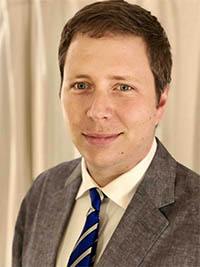 Will Payne, Ph.D. joined the Bloustein School as an Assistant Professor. He received his PhD in Geography from the University of California, Berkeley, where he also was affiliated with the Berkeley Center for New Media, the Berkeley Food Institute, and the UC Berkeley Global Urban Humanities Initiative. Will uses quantitative and qualitative methods to study the relationship between geospatial technologies and urban inequality, examining how changing technical capabilities, labor relations, and competitive pressures in the location-based services (LBS) industry interact with processes of racialized and class-based segregation in American cities. He has published articles in the Annals of the American Association of Geographers, Urban Geography, Computational Culture, and Environment and Planning A, among other publications. Will’s current book project examines how different groups of urban residents use “urban information systems” like the Zagat Survey, Yelp, Foursquare, and Google Local to organize and understand their consumption experiences in cities, while technologists and real estate developers employ the resulting data to help transform marginal neighborhoods into upscale consumption spaces. Will also develops open-source tools for spatial data visualization and computational research.

Wenwen Zhang, Ph.D. joins the Bloustein School as an Assistant Professor. She received her Ph.D. from Georgia Tech’s School of City and Regional Planning in 2017. She also earned her Master’s in City and Regional Planning, Civil Engineering, and Computational Science & Engineering from Georgia Tech. Previously, she was a research assistant at the Center for Spatial Planning Analytics and Visualization (previously known as CGIS) for six years and an assistant professor of Urban Affairs and Planning at Virginia Tech for three years. Her research focuses on the social and policy impacts of emerging transportation technologies, such as automated vehicles, ride-hailing services, and micro-mobility, and leveraging data science and visualization techniques to address critical urban planning issues. She has published 16 journal articles, 15 conference proceedings, and one book chapter. She has served as a guest editor for Transportation Research Part D: Transport and Environment.