
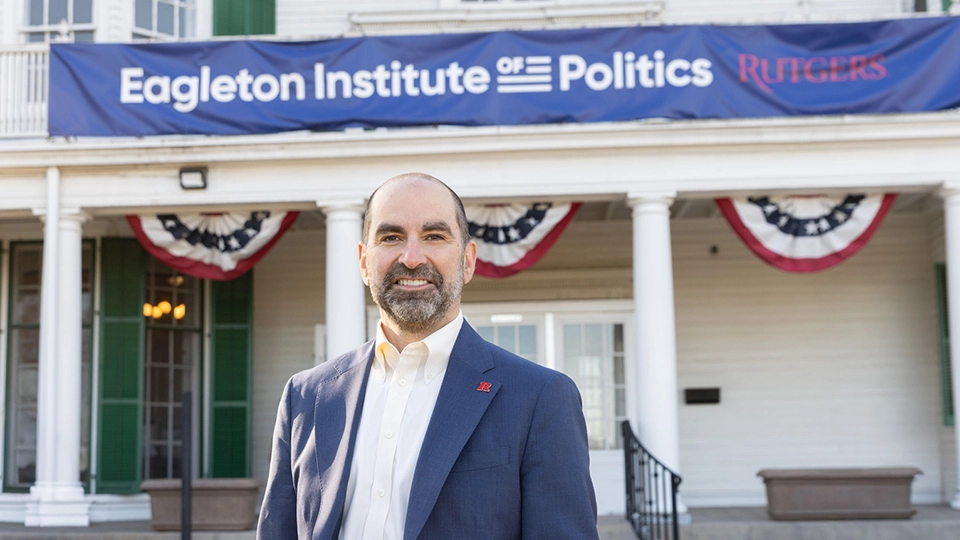
Nicholas V. Longo is leading a university-wide effort on how to expand engagement in civic life
Nicholas V. Longo, the inaugural director of the Rutgers Democracy Lab, insists democracy is something you learn by doing – not just in a classroom or at the ballot box, but in the everyday work of navigating challenges, listening to others and finding common ground.
His approach comes at a time when colleges and universities are rethinking how to prepare students to engage in civic life in an increasingly polarized world.
“Young people care deeply about issues,” Longo said. “They want to make a difference, but they don’t always know how to act on them.”
Launched in 2025, the Rutgers Democracy Lab at the Eagleton Institute of Politics is a university-wide effort to strengthen U.S. democracy through education, dialogue and collaborative problem-solving. The lab was built to engage students throughout the university, regardless of major, through paid opportunities and internships, credited courses, electives and interactive learning experiences.
“The Rutgers Democracy Lab is poised to lead transformational change that is vital to the health of our nation’s democracy,” said Jason Geary, provost and executive vice chancellor for academic affairs at Rutgers-New Brunswick.
The work is both urgent and personal for Longo.
“I want to make the world a little bit more democratic for the next generation,” he said. “I want to do that for my kids, and I want to do that for students.”
Longo traces that commitment to more than 20 years of working with college students throughout the nation, including roles with Campus Compact, a national civic engagement coalition and institutions such as College Unbound, which focuses on community-based education for adult learners. He is also a professor in the Edward J. Bloustein School of Planning and Public Policy.
Geary said Longo “possesses the skills, experience and creativity to realize this bold vision by fostering connections across Rutgers and the broader community.”
A New York native, Longo came to Rutgers from Providence College in Rhode Island, where he was chair and professor of global studies and co-directed the Dialogue, Inclusion and Democracy Lab. He saw an opportunity to take that work further at Rutgers.
“There is no better place to do this,” he said. “We can reach students across the university and at a scale that can really make a difference.”
One of the lab’s flagship initiatives is the Think and Do Tank, a yearlong program that brings together about 25 students from a range of majors and backgrounds to identify issues they care about and develop real-world solutions to address them. The paid program offers academic credit and emphasizes hands-on, applied work.
The Think and Do Tank is recruiting its next cohort of fellows, who will begin in September. Applications close April 15.
Another initiative, Talking Across Difference, helps the Rutgers community engage in productive conversations across political and social differences through workshops and campus programming. A new cohort will be selected for the 2026–2027 academic year as part of a paid co-curricular program that helps Rutgers-New Brunswick students develop facilitation skills and lead constructive dialogues.
Faculty and staff also may get involved as Democracy Fellows, supporting cross-disciplinary projects and research on democratic engagement. Applications open in the spring.
The lab also supports graduate research through a new Democracy Summer Fellowships program and is expanding into areas such as technology and democracy, including a summer research internship focused on how social media and artificial intelligence shape civic life, with applications open through April 19.
For Varshini Rajanikanth, a sophomore double majoring in political science and finance from Edison, N.J., that work already is taking shape.
Born in India and now a first-generation American, Rajanikanth is part of the inaugural Think and Do Tank cohort. She works with four students from different majors, peers she said she wouldn’t have met otherwise, on a proposal to secure state-subsidized NJ Transit funding for Rutgers students traveling to internships, particularly those from immigrant and lower income backgrounds.
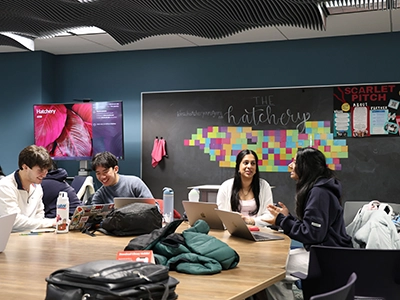
Students from the Think and Do Tank cohort collaborate during a session at the Hatchery, including Varshini Rajanikanth (right).
“What I really love about the Think and Do Tank is that it’s so student-oriented,” she said. “The professors are there to guide us, but it’s really up to us to shape the program and the work we want to do.”
Rajanikanth also is working with Longo on the Common Ground Initiative to create a physical “third space” on campus, envisioned as a café-style environment where students can come together to engage in dialogue across differences.
“The Rutgers Democracy Lab makes it possible for all Rutgers students – across disciplines and across campuses – to build a skillset for engaged democratic citizenship,” said Elizabeth Matto, director of the Eagleton Institute of Politics and acting director of the Center for Youth Political Participation.
Rajanikanth, who plans to attend law school and is interested in how policy and finance shape access to opportunity, added, “I’ve always been interested in making sure people feel heard and that their voices are represented.”
Longo wants every Rutgers student to graduate with both the knowledge and confidence to engage in civic life.
That vision will be on display in April during Solving Grand Challenges Month, a series of public events focused on real-world problem solving. Programming includes a “Citizen Activist Advocacy” workshop and a health policy session in which students explore active legislation and take part in hands-on advocacy, including drafting communications to congressional offices.
Other events examine how artificial intelligence is shaping political communication and public trust as well as programming focused on art, film and climate.
The month will conclude with an invitation-only national conference at Rutgers, along with a campuswide showcase on April 23 at the Cook Student Center highlighting student and faculty work in democracy-related research and practice.
Longo said he remains hopeful about democracy because of young people’s potential to lead change.
“We don’t have to wait for someone to come save our democracy,” he said. “They’re already here. It’s students. It’s all of us.”