
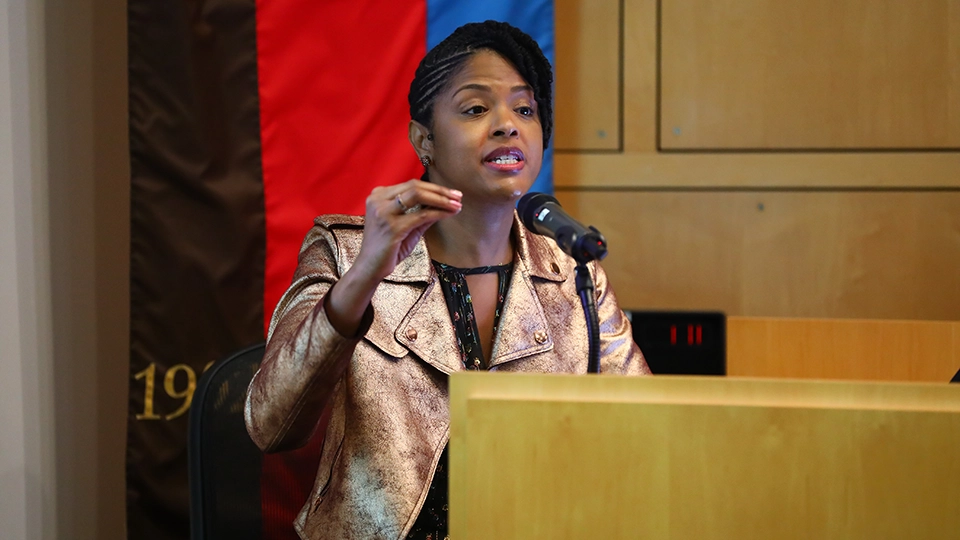
Dr. Chris T. Pernell, director of the NAACP Center for Health Equity, speaks at the Bloustein School’s annual Community and Belonging lecture.
Dr. Chris Pernell highlights health justice, systemic inequality, and community engagement at Bloustein School’s annual Community and Belonging lecture
On March 4, the Bloustein School welcomed physician, public health, and social justice advocate Dr. Chris T. Pernell, director of the NAACP Center for Health Equity, for this year’s Community and Belonging Lecture, “Exodus From Tyranny: Fighting for Just Systems as a National, State, and Local Imperative.”
Dean Stuart Shapiro opened the lecture by emphasizing the Bloustein School’s continued commitment to equity and inclusion. He then introduced Dr. Patti O’Brien Richardson, the school’s Chief Community and Belonging Officer.
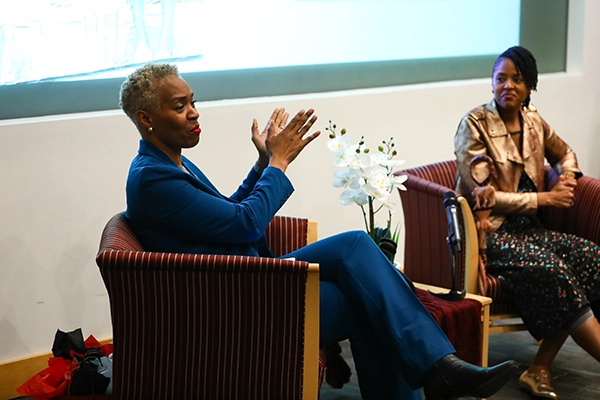
Dr. Patti O’Brien Richardson (left) and Dr. Chris T. Pernell answered student and audience questions at the end of the lecture.
Dr. Richardson reinforced the importance of community and belonging, especially during the current challenging times. She acknowledged the collaboration from across Rutgers University for the event, recognizing the Rutgers School of Communication and Information, Douglass Community Engagement, and the Rutgers Center for Social Justice Education and LGBTQIA+ Communities as strategic partners.
Dr. Pernell then delivered a wide-ranging talk on health justice, systemic inequality, and the role institutions and individuals play in addressing inequities in health and society, noting that the topics being discussed are constantly evolving.
In a rapidly changing political and social environment, she said, public health leaders must remain responsive to the realities communities are facing. Using the metaphor of a fruit tree leaning to one side, she explained how equal treatment alone does not solve structural problems.
In her example, two people stand on identical ladders trying to reach fruit from a bent tree. Because of the angle of the tree, there are fewer resources for the person on the higher side. Dr. Pernell explained that while equality provides the same ladder for everyone, equity adjusts the ladder’s height to compensate for disparities. Justice, she noted, requires addressing the root cause of the imbalance.
“I want you to think about what you do on a daily basis, and whether your work is just giving the community equal ladders. Or if your work is giving the community a ladder that is more specific to their needs and their priorities. Or if your work dares to make the tree upright. And that,” she emphasized, “is the most difficult work of all.”
“Unless we…uproot the tree and deal with the soil, unless we work on the system itself, the populations that we are seemingly serving will still be confined to the same set of circumstances and reality. Is it justice there, if you’re still trapped?” she continued.
Dr. Pernell then talked about the concept of health justice, described as ensuring the conditions necessary for optimal health for all people. She explained the importance of “assurance,” the idea that systems must guarantee access to care rather than simply make it theoretically available.
To provide examples of what assurance can look like in practice, she drew on lessons from the COVID-19 pandemic and cited policies such as universal access to testing and vaccines, and the temporary suspension of Medicaid disenrollment. She also shared personal experiences to illustrate other challenges faced by marginalized communities in the healthcare system.
Using analogies and examples to explain the impact of systemic inequality on health outcomes, she described health disparities as the result of three major factors: differences in life exposures, differences in access to care, and differences in the quality of care received.
“A lot of that,” she noted, “Is being determined by your backyard. A lot…50 percent of these factors, can be traced back to your zip code.”
She explains that one’s “backyard” is more than just the immediate vicinity; that it has many concentric layers that determine everything from environmental conditions and educational opportunities to life expectancy.
“It’s so important to begin to understand what is in our backyard, meaning the systems, the institutions, the assets, as well as the gaps towards the deficits,” she said, “Because you can’t really begin to plan interventions without knowing what the ‘what’ is.”
The United States, she continued, often prides itself on its health care system. But when compared to peer countries, it is found to be lacking. She encouraged attendees to look into the Commonwealth Fund’s Mirror, Mirror 2024 report comparing the performance of health systems in selected countries to highlight how they might inform health system improvement in the U.S.
Even within the U.S., she pointed out that New Jersey is often considered superlative in the care it provides. But when analyzed further, New Jersey, just like the rest of the country, struggles with providing equitable care to marginalized communities. She used the Commonwealth Fund’s 2025 Scorecard on State Health System Performance as evidence of some of the worst disparities in median household income in White versus Black and Latino households as being in New Jersey.
Dr. Pernell emphasized that these inequities continue to be sustained by the institutional structures and policies that organize opportunity and disadvantages. Addressing these systems, she argued, requires identifying who holds power and how that power can be leveraged.
“In any ability to design, to carry out an intervention—whether it’s local, whether it’s state or whether it’s national—you have to activate community. You have to understand who community is, and you have to understand who has power in community, and how to coach your power with community,” she said.

Dr. Patti O’Brien Richardson, Dr. Chris T. Pernell, and Bloustein School Dean Stuart Shapiro.
Effective intervention and change, she concluded, depends on community engagement, and building knowledge through research and collaboration. There must be a willingness to use what you learn to deliberately shift the narrative through storytelling, centering justice, and disrupting systems.
“Once you center equity, if you’re not using it to disrupt systems, go back home. And…you got to know how you’re going to do that. You can’t do that alone….we must share power and expand leadership through collaboration.”
Closing her remarks, Dr. Pernell encouraged students and future policy leaders to remain bold in their advocacy. One of the most effective tools for change, she said, is personal narrative. “Don’t underestimate the power of storytelling…Wield your own story and policy if it is relevant, or wield the stories of others,” she advised. “That’s why we’re able to change policy. Because usually some policymaker or decision maker either gets shamed, embarrassed or connected to a story, and then you get a piece of legislation or regulation that works in your favor.”