
by Sarah Small and Debra Lancaster for New Jersey State Policy Lab
In the US and around the world, growing evidence indicates women have borne the brunt of the economic crisis and social upheaval triggered by the COVID-19 pandemic. New Jersey is no exception. In a forthcoming report from the Center for Women and Work — funded by the New Jersey State Policy Lab — we explore the extent to which increased demand for unpaid care work, wage gaps, and income precarity affected women in New Jersey during the pandemic.
Many women across the state have struggled to fully participate in the paid workforce given the ongoing disruptions to childcare and K-12 education caused by the evolving public health crisis. Census Household Pulse Data indicate that from April through December of 2021, nearly one-quarter of New Jersey households with children under age 12 experienced a disruption to their childcare arrangements.
Childcare disruptions are not experienced in the same way across all households. Families with higher household incomes tend to work within occupations that offer more flexibility and opportunity to work from home; not surprisingly, higher-income households are twice as likely to report that they are providing supervision to their children while working than their peers from lower-income households. Lower-income households are less likely to report supervising their children while they work, and more likely to experience economic consequences in the form of lost income and even lost jobs.
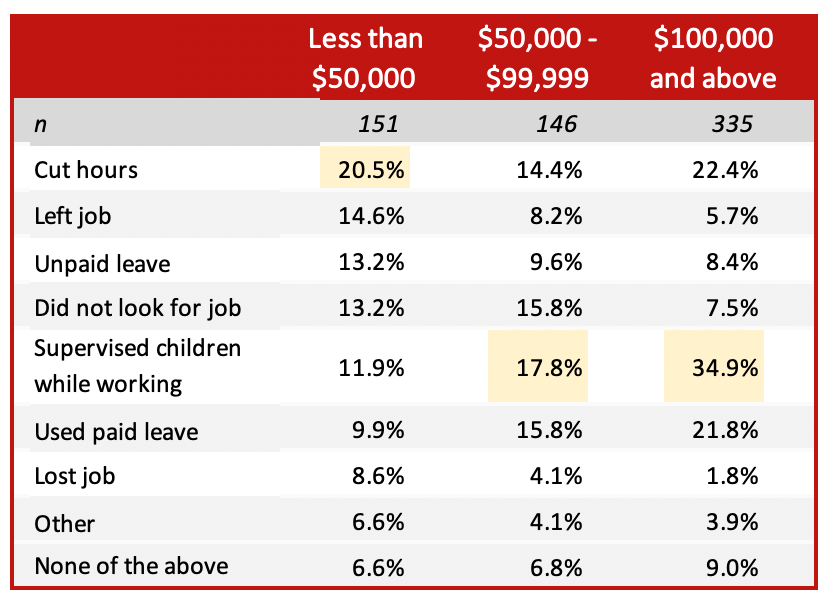
For instance, among New Jersey households with children under age 12 that earned less than $50,000 annually, 20.5% indicated they had to cut work hours due to a childcare disruption. Almost one quarter (23%) indicated that someone left or lost their job as a result of the childcare crisis. By comparison, among households earning $100,000 or more, larger shares cut their work hours (22.4%) or used paid leave (21.8%), while only 7.5% indicated a household member left or lost their job due to childcare disruptions.
Which if any of the following occurred in the last 4 weeks as a result of childcare being closed or unavailable?
Note: Weighted 2021 data for weeks 28-40, disaggregated by household income. Sample limited to New Jersey households with children under age 12 experiencing care disruptions. Respondents could select more than one response, so percentages sum to more than 100%. Top responses are highlighted in gold.
Supporting caregivers’ ability to stay in the workforce, the Child Tax Credit payments have provided critical support to lift families out of poverty by helping parents care for their loved ones and put food on the table. While we wait to see if the Child Tax Credit will be extended at the federal level, New Jersey could prioritize additional policies and programming that enable NJ residents to care for their families.
Childcare and early education is an essential service for working families and can make invaluable contributions toward the healthy development of our youngest residents. Our analysis indicates that the COVID childcare crisis has contributed to the income precarity of low-income families, while upper-income households were more likely to use paid leave or reduce their work hours. Investments in New Jersey’s fragmented childcare infrastructure are essential to address not only the challenges that COVID has created, but also challenges that will persist after the pandemic. For example, identifying mechanisms to increase the notoriously low wages and benefits of the childcare and early childhood workforce will go a long way towards stabilizing the field, as it has been slow to recover since the early days of the pandemic.
Families also need support to take time off from paid work to care for their loved ones during both pandemic and non-pandemic times assured they will have a job to return to. New Jersey has been a leader in advancing policies to support working families and offers both earned sick days and paid family leave. Yet, we know that passing legislation is only one step in realizing the promise of such policies. Identifying policy and implementation gaps, collecting, and analyzing utilization data, and providing pathways to enforce these laws are all essential to help the workforce enjoy equitable access to paid time off to care for themselves and their loved ones.
The Center for Women and Work is partnering with the New Jersey State Policy Lab to envision deeper solutions to the problems wrought by the childcare crisis.