
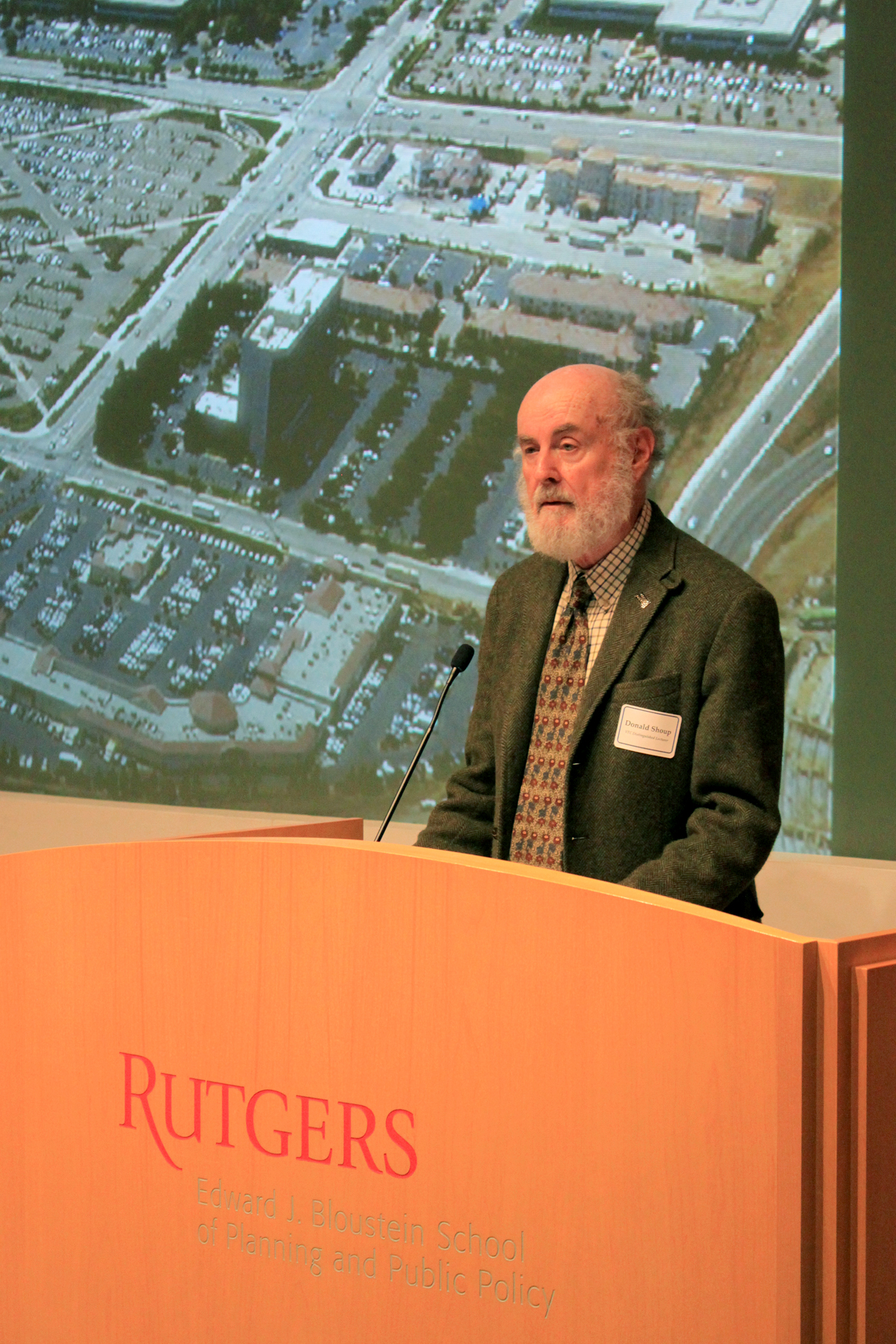
 Donald Shoup may not be a household name to the everyday citizen, but his field of study is one that everyone has an opinion about—parking. Described as a “parking rock star” in urban planning circles, the UCLA professor entertained over 100 attendees at the 2015 Alan M. Voorhees Distinguished Lecture in the Special Events Forum on October 1.
During his hour-long lecture, “The High Cost of Free Parking,” discussing his research on urban parking policy, Dr. Shoup entertained with witty one-liners about himself, his research, and the state of urban parking across the country. With a backdrop of photos, graphs and charts, the self-professed “Shoup Dogg” compared parking in California, New Jersey and across the United States.
Dr. Shoup noted that while most parking is free to drivers across the country, there are actually many high costs associated with parking that are passed on to residents and taxpayers of an area. He advocates three different means to use in concert with another to achieve an equitable urban parking policy: first, charge the right price for parking spaces; second, to create “parking benefit districts” so neighborhoods receive all the revenue from their own neighborhood parking spaces; and third, to reduce or remove minimum parking requirements.
As an example of charging the correct price for spaces, Dr. Shoup pointed to SF Park, a program implemented in 2011 in San Francisco that utilizes smart parking meters to create dynamic pricing structures based on current availability of on-street parking spaces. He used Old Pasadena as an example of a successful Parking Benefit District. Unfortunately, minimum parking requirements remain widespread throughout most American cities, although he pointed to some places such as Zurich, Amsterdam and even San Francisco as places that are using parking caps.
Dr. Shoup believes that by using these three measures, urban parking prices can better reflect the actual cost of a space as well as what people can—and will—pay for that amenity. He thinks that people across the political and economic spectrum could and should be unified by these principles since it adheres to the market while creating government structures, lowering carbon emissions, increasing customer decisions, allowing for personal determination of pricing, lowering development costs, and increasing direct funding for neighborhoods.